Showing posts with label recipe. Show all posts

Monday, August 17, 2009

Peach Pickles!

- Beth Brandon

I could write about a million things right now, since I just returned from
my good friend Katie's farm in Cranston, RI where I've been working and playing and swimming and eating for the past week and a half.

I think I'll start with this: pickled peaches (since my other post was about peaches, and I now have a new favorite to add to my repertoire of things to do with stone fruits).

I spent a day home from the farm to make pickles, sauerkraut, and homemade mayonnaise, which will certainly be in an upcoming post... My day of pickling was fairly freestyle, perhaps because I have a good deal of experience with pickles and perhaps because I was on vacation. In any case, I recommend you start out with this basic proportion:

2 c. honey
1 pint vinegar - white or red wine or mixture of both
about 5 lbs. of peaches, pitted and sliced

I kept the skins on the peaches, but you can remove them if you like. There's a possibility that your skinned peaches will turn brownish after a while, but adding some lemon juice to each jar would probably help.

Put the honey and vinegar in a large heavy pot. Add to that your typical pickling spices; here are some suggestions:

coriander seeds
fenugreek seeds
mustard seeds
black peppercorns
whole chili peppers
cinnamon stick
allspice
whole cloves

Bring this mixture to a boil and simmer for about 10 minutes.

Pack raw peach slices into hot, sterilized jars. Ladle hot vinegar-honey mixture over peaches, leaving 1/2" head-space at the top of the jar. Assemble 2-piece caps.

You can either let the jars cool and put them in the fridge to eat within the next few months, or process the jars in a boiling water bath for 10 minutes. (Processed, the pickles will keep unrefrigerated for up to 1 year.)

I'm leaving out a lot of details on the ins and outs of canning, but if you're new to it, look here for a helpful guide.

Using the same recipe but with the addition of garlic cloves, I made some of the best pickled carrots I or any of my friends had ever tasted! Now is the time. Make some pickles and pull them out in 8 months when crispy and fresh have all but left your taste vocabulary.

Thursday, August 13, 2009

Blistered in the Sun


Been really busy lately and haven't had much time to post, but tonight came home and decided it was time to get busy in the kitchen. Had some beautiful lamb in the freezer, and our fridge was loaded with farmers market produce. This included some baby eggplants that were calling to me. Lamb+eggplant is a natural combination. So here's the menu:

• Local red lettuce and tomato salad with sprouts and sweet peppers; dijon-balsamic vinaigrette
• Roasted "Charmoula" marinated lamb loin, with mint-garlic pesto, on eggplant-garlic-pepper puree.
• Corn on the cob
• Blistered shishito peppers with pink sea salt

Not going to post full recipes here, but here are some details.

"Charmoula" is a somewhat generic term for a north-African olive oil based spice paste, that generally includes ground chilies, cumin, salt, garlic, lemon, onion, coriander, saffron, etc. For this particular spice paste, I used:

olive oil
pimenton (smoked Spanish paprika)
sweet paprika
ground cumin
minced garlic
cayenne
allspice
ground black pepper
turmeric
kosher salt
dash of white wine vinegar (didn't have a lemon, but needed acid)

The eggplant puree was actually one of the best concoctions I've come up with in a while. Started by blackening the eggplants on all sides in a cast-iron skillet. After about 20 minutes, I let them cool, then peeled them and scooped out the softened flesh. Next, pureed in a food-processor with a little bit of salt and pepper. Meanwhile, sauteed finely diced garlic, hot peppers, sweet peppers, and zucchini until all were softened (but still slightly firm), and folded it all together. This creamy, spicy-sweet puree was a perfect compliment to the lamb (but tasty as hell on it's own)

The pesto was just fresh mint, olive oil, and garlic with a bit of fresh black pepper. Brightened the whole thing up and transformed a pretty comforting meal into a much more summery affair.

Shishito peppers are the closest thing to pimientos you can get around here. These small, tender, slightly spicy peppers are best prepared simply: tossed with a bit of olive oil, and blistered in a hot cast-iron skillet (or grilled), and tossed with a bit of sea salt. I have to get them fast.... Dunnie will make these disappear in a flash.


Shishito Peppers

Lamb loin chop w/ mint-garlic pesto, eggplant-pepper puree, corn on the cob

Blistered shishito peppers

(You can see I got jipped on these suckers!)
(Dunnie ate twice as many as me)

Wednesday, August 5, 2009

Farm(ers Market) to Table


Farm Food
Originally uploaded by Utter Brandomonium

Both last night and tonight, dinner preparation had a dual purpose: make something to eat, and to use up some (slightly) aging produce. Tonight's was not your run-of-the-mill dinner by any means. A farm egg scramble with the unbelievable eggs from Knoll Crest Farms, some Salumi, spring onions and rosemary from my window. And a salad of early tomatoes, raw sweet corn, red quinoa (brought back from Peru!), fresh mint, and chili flakes. YUM!

Thursday, July 23, 2009

My Favorite Use of Peaches

- Beth Brandon

Based on the newsletter I just got this week from my local farmstand, it is time to go stock up on tree fruits: apricots, peaches, plums, and nectarines. Why? Well, not only to can them in light syrup or make pies or jams or, well, to eat them, quite sloppily, with juice dripping down my chin... but to FREEZE THEM, in chunks, making what I like to call the most delicious ice cubes ever for a winter whiskey drink.

If you want to keep it all close to home (those of you in the New York area), go get yourself some Tuthilltown Spirits Hudson Baby Bourbon.

I warmed the hearts of many guests in the cold weather months with this simple, wholesome victual. Let the fruit melt in your drink until you're done and then eat the slippery, liquor-soaked peach that's left in your glass. Heaven.

When freezing these fruits, choose fruit at the peak of ripeness and discard any bad spots. Cut out the pit, cut fruit into chunks (whatever size you like), and fill new freezer bags, pushing out air as much as possible before sealing.

You can also freeze fruits (and any foods, for that matter) in glass or plastic containers. As much as I love my glass mason jars, though, it is much easier to disengage the frozen-together chunks of fruit when they are in a plastic bag than in a container. Rather than stabbing into a container with a knife and risking bodily harm, you can take the sealed bag and hit it against a hard surface like your counter top to break it up.

Wednesday, July 22, 2009

Dunnie's Din


din
Originally uploaded by Utter Brandomonium

Got home from the gym and Dunnie was choppin' away. I chipped in minimally, and we had a wonderful, fresh, veggie-based dinner:

Salad of mixed organic greens from the farmers market, corn, kaniwa (quinoa-like grain from Peru), beets, radishes, cucumber, tomatoes, and red peppers, with lemon-parsley-shallot vinagrette

Garlic, ancho, cumin shrimp on wilted kale with garlic scapes and red onion

No recipes today!

Monday, July 20, 2009

Another Repice (no, not a typo)


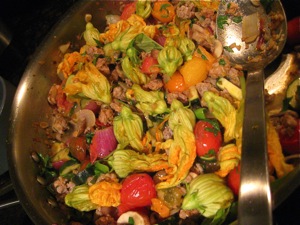
This is one of my summer favorites. It's a simple recipe (or "rep-uh-see" as my mother calls it) that features one of my favorite summer ingredients: the squash blossom. Their sweet, delicate earthiness, paired with acidic tomatoes, spicy Italian sausage, and finished with Parmesan Reggiano cheese make for a balanced, delicious, light summery pasta dish.

Orecchiete with Sausage, Heirloom Tomatoes and Squash Blossoms
1 lb orecchiette (or rotini if unavailable)
1 medium yellow onion, rough chop
5 cloves garlic, minced
8-10 crimini mushrooms, thick slices
1 lb grape or cherry tomatoes (I used an heirloom variety)
1 1/2 lbs hot italian sausage (or 1/2 hot, 1/2 sweet), casing removed, chopped
12-15 squash blossoms, cleaned and de-stemmed, with pistle removed
1 medium zucchini, 1/4 in thick coins
12 fresh basil leaves, roughly torn
2/3 cup fresh parsley, chopped
1/2 cup freshly grated Parmesan Reggiano cheese
1 tbsp red chili flakes
3 tbsp extra virgin olive oil
kosher salt and fresh black pepper

In large, heavy-bottomed 5-quart saucepan, brown sausage in 1 tbsp olive oil over medium heat. Don't worry too much if it sticks to the bottom - these tasty goodies will be deglazed later. Just make sure the sausage doesn't burn. After 8-10 minutes, or when sausage is browned and cooked through, remove from pan and set aside.
Deglaze the pan with a small splash of water (1-2 tbsp) and scrape up browned bits. Once water is gone, add remaining oil, garlic and onions, and sweat 2-3 minutes, until softened but not browned. Season with a pinch of salt and pepper at this point. Add tomatoes and cook until tomatoes have wrinkled and some have burst. If pan is dry, add a bit more water.
At this point, cook pasta. Most dried orecchiete takes 9-12 minutes. Cook for 90 seconds less than recommended, as the pasta will be cooked a bit more in the final stage.
Next, add the zucchini and mushrooms to the onions and tomatoes, and cook 4 to 5 minutes until softened. Finally add squash blossoms, sausage, hot pepper, and re-season with salt and pepper. Lower heat to medium-low and toss until blossoms have wilted. If pasta is not done, remove pan from heat.
Drain pasta, reserving a bit of the pasta water, and immediately add to the pan with the sausage and vegetables. Add parsley and basil, and a bit of pasta water if needed, and finish with 3/4 of the Parmesan. Finish with fresh black pepper and a good, grassy extra virgin olive oil.


A New, Long-Term Relationship


Many people have asked me how I got "into the whole food thing", as it pertains to this blog. Sustainability, local food, slow food, anti-industrial food, food politics (a la Marion Nestle), and what not. It was actually inevitable, when I think about it. I have been an environmentalist of sorts for as long as I can remember, and have been brought up with core values that stress justice, truth, open-mindedness and acceptance. I thank my parents, grandma Gloria, and the particularly progressive brand of Judaism at my temple (and Mike Robinson, my first rabbi). These formed the base.

As a child, I was quite the "tinkerer", ever diving into mountains of Legos, Lincoln Logs, building blocks, train sets, or anything else that could be used as raw building materials for the project at hand. I liked the process, and felt great pride with the results. When I left for college, I was dead-set on engineering. You may be wondering how this has anything to do with food or cooking. It didn't, yet.

Then learned to make my mothers Lemon Chicken.

Cooking was never the abstract, distant, scary thing to me that it is to many people these days. It's just a process, and it always made sense. I would man the BBQ, make some eggs or french toast, make sandwiches and perform some basic tasks in the kitchen, but never really had to fend for myself. The first kitchen I had was sophomore year of college, when there was a 2-burner electric range, small oven, and a sink in the lounge of my dorm. So in my first attempt to cook anything "real", I called up a few friends and declared I was making dinner. It came out pretty darn good.

From that moment on, I knew that cooking was far more than just combining some ingredients, heating most of them up, and eating the finished product. Cooking, and the sharing of a collective meal, is as old as human civilization itself. Eating is the rarest of activities that combines all the senses at once. It caters to the most basic human needs of community, nourishment and comfort.

What began that day was not just a love of food and cooking, but a long-term relationship with the ingredients provided by the earth. And as my interest, experience, and sophistication grew, so did my understanding of the fragile, beautiful gifts that make it into my fridge and pantry. This blog, and my deep interest in what we eat and where it comes from, is the culmination of my most basic values, and experience as an eater and a cook. I admit to unabashed selfishness, however. I want the best ingredients, and they happen to be local, usually organic, and always the freshest possible. A world dominated by impersonal, wasteful, industrial food challenges me on a very deep level.

With that, I will post the first of what will hopefully be many recipes. This is a simple, delicious, wholesome (and awfully wintery, excuse the lack of seasonality) dish.

My mothers Lemon Chicken (updated ever so slightly)

Ingredients:
4 boneless free-range chicken breasts
1/2 cup chicken stock
1/2 cup Parmesan Reggiano cheese, freshly grated
2 cloves garlic, smashed and diced
1/2 cup fresh parsley, chopped
1/2 cup all-purpose flour
2 eggs
1 large lemon, cut in half with 4 thin slices taken out of thickest part
1 tbl milk or half-and-half
1 tsp pimenton (smoked Spanish paprika)
1-2 cups fresh bread crumbs (any old bread in a food processor will do)
1 tsp freshly ground black pepper
1 tsp kosher salt
4 tbl extra-virgin olive oil

Pre-heat oven to 350 deg F.

In a medium saucepan, heat 2 tbl olive oil and garlic over medium heat. When garlic starts to pop and begins to turn a light golden color, add the bread crumbs.Toast breadcrumbs until they are light golden brown throughout. Season with salt and pepper and half the parsley. Remove from heat and set aside.

In 3 medium shallow dishes, set up your breading station, one with flour, salt, pepper and pimenton, one with beaten eggs and milk, and one with the breadcrumbs. Meanwhile, heat remaining olive oil over medium heat in large saucepan. One oil shimmers, begin the breading and frying process. Dust chicken breasts with flour, making sure to pat most of it off, just barely coating. Then dip in egg and milk mixture, letting excess drip off. Finally dredge in bread crumbs, pressing them into the chicken to make sure they adhere. Finally place chicken in saute pan. Repeat with remaining chicken, keeping track of the order in which they went into the pan. Cook 2-3 minutes per side, until breadcrumbs are a medium brown and a crust has formed.

Place chicken in lightly-greased baking dish. Pour a bit of chicken stock and squeeze the lemon (not the slices) all over the chicken and into the baking dish. Make sure the chicken is not swimming in liquid or the breading will become soggy. Cover with aluminum foil and bake for 12-15 minutes. Next, remove foil, and sprinkle the cheese over the chicken. Bake another 5-8 minutes, or until top of chicken is crispy and the cheese has melted. Garnish with remaining parsely.

Serve with couscous or brown rice, and a simple wilted green such as kale or spinach. A bit of fresh ground nutmeg is an excellent additional seasoning.